Guest blog Martijn Aalbrecht: planting a tree, step by step guide
This month we have something special: our first guest blog on My Food Forest! None other than Martijn Aalbrecht, also known as De Voedselboss, wrote a blog for us on how to best plant a tree in your food forest. The planting season is almost here, so these steps come just in time!
Since the beginning of this year, besides the app we have also been creating our own food forest. Martijn has helped us with that. The design is now finished, and this autumn the first trees will go into the ground.
If you had told us a year ago that there were so many steps involved, we might have given you a funny look. Planting a tree is just digging a hole and putting the tree in, right? Well, apparently there is quite a bit you can do to give your new trees a good start. What exactly? Martijn will tell you himself.
Martijn speaking
Fifteen years ago I planted my first food forest. I now have three food forests of my own and in that time I have picked up quite a lot of knowledge, often by doing things wrong. With my first planting I made several mistakes. I planted trees too deep, which made some trunks rot. I also did not tie them firmly to a thick bamboo cane, so over time they started to lean and some snapped in a storm.
There are really three moments that matter for a successful planting: what you do before you plant, the planting itself, and what you do afterwards. I will take you through all three.
Before you plant
A tree’s success depends largely on where you put it and the condition it goes into the ground in.
- Assess the spot. Is there a good balance between sun and shade? Is there enough shelter from the wind? Is the soil well drained and free of compaction? And is the plant big and sturdy enough for this spot? Fruit trees benefit especially from morning sun: it dries the dew quickly, which reduces disease pressure. Wet feet or a hard layer beneath the roots are fatal for most trees.
- Protect the roots. This applies especially to bare-root plants: keep the roots moist at all times and leave the plants unprotected for as short a time as possible. Heel them in if you are not planting straight away. Carefully cut away damaged roots.
- Remove the bamboo cane and tying material from the nursery.
- Stand the plants with their roots in a bucket of water for a few hours, so they can soak up plenty of water.
The planting
A good planting hole gives your tree a flying start: the roots can easily grow into the soil and immediately find the nutrients and soil life they need.
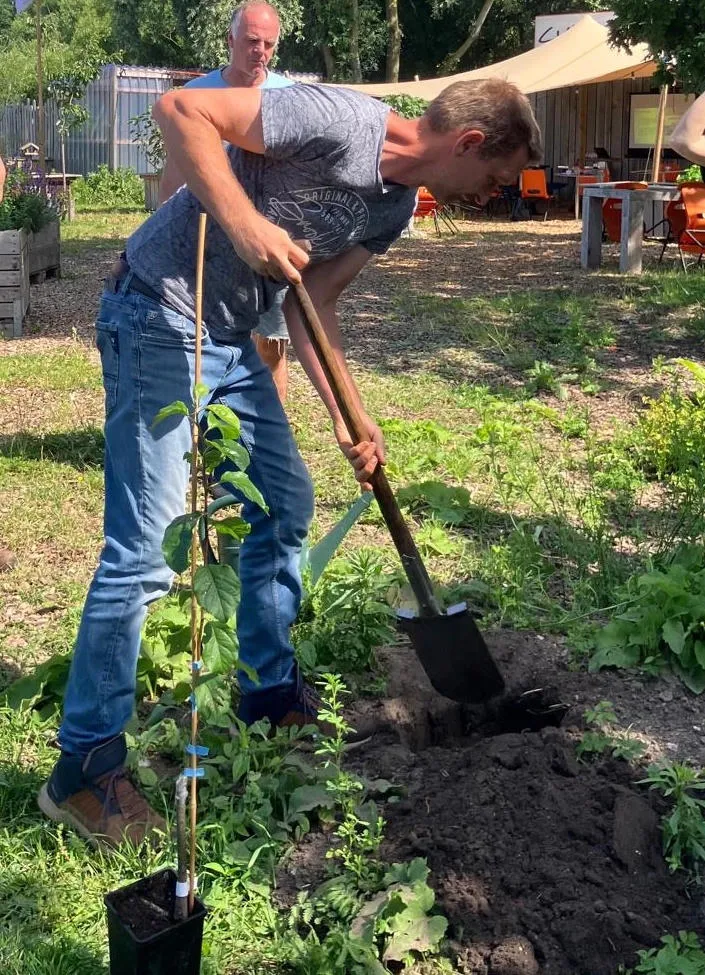
- Dig the planting hole 2 to 3 times as wide as the root ball and 2 times as deep.
- Put a sturdy bamboo cane in the middle of the hole. Do this now, so you do not damage roots later.
- Enrich the excavated soil. Mix in old, fungi-dominated compost (or Vivimus if you do not have good compost) and sprinkle a little forest soil into the hole for faster fungal colonisation. On sandy soil, a little lime or gypsum helps.
- Place the tree snugly against the bamboo cane and spread out the roots. When planting from a pot: loosen the roots well first, so they do not keep growing in the shape of the pot. Does the plant have a taproot? Point it north.
- Plant exactly as deep as the tree stood at the nursery, certainly not deeper. A tree planted too deep can struggle for years.
- Fill the hole with the mixed soil and press down lightly. Make sure the soil is loose, without big clumps, and do not press too hard: the roots need air.
- Tie the tree to the cane with tree tie tubing.
- Straight away, slowly give 1 to 2 watering cans of water. This removes the last air pockets and lets the roots make good contact with the soil.
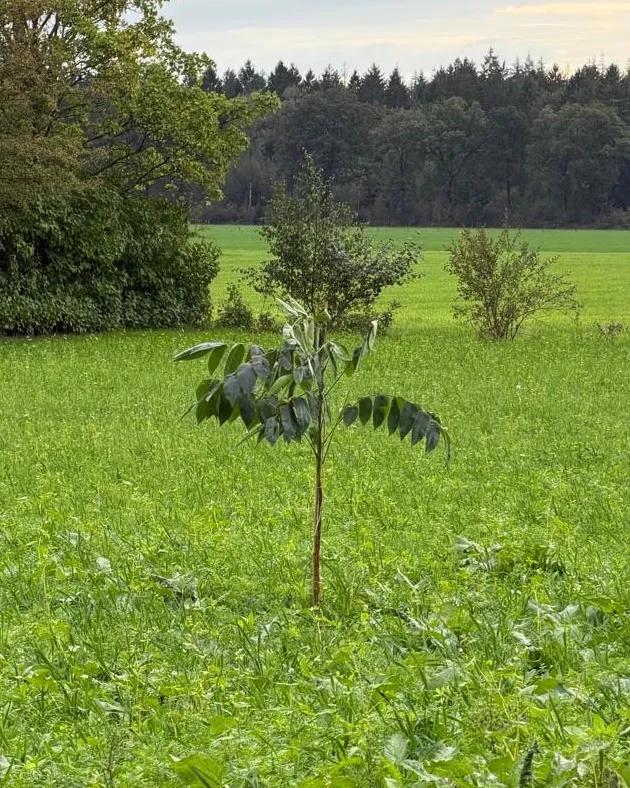
Tip: mulch around the tree with wood chips or leaves (keep the trunk itself clear) and make a low ridge around the tree, so the water stays where it is needed later.
After planting
Especially in the first year, a young tree does not yet have a deep root system and depends on what you give it.
- Water regularly, especially in dry periods. About one watering can per tree. Better a lot once than a little often: that way the water reaches the roots and the tree learns to root deeper. Young plantings dry out faster than you think.
- Feed through the water. Mix in homemade liquid feed (for example nettle), liquid from your worm bin or a little ripe compost. A splash of molasses feeds the soil life, and a handful of forest soil brings the fungi and bacteria that help the tree take up nutrients.
Those were all the steps. It may seem like a lot, but in practice you spend about a quarter of an hour per tree, and that quarter of an hour largely determines how well it will establish over the coming years.
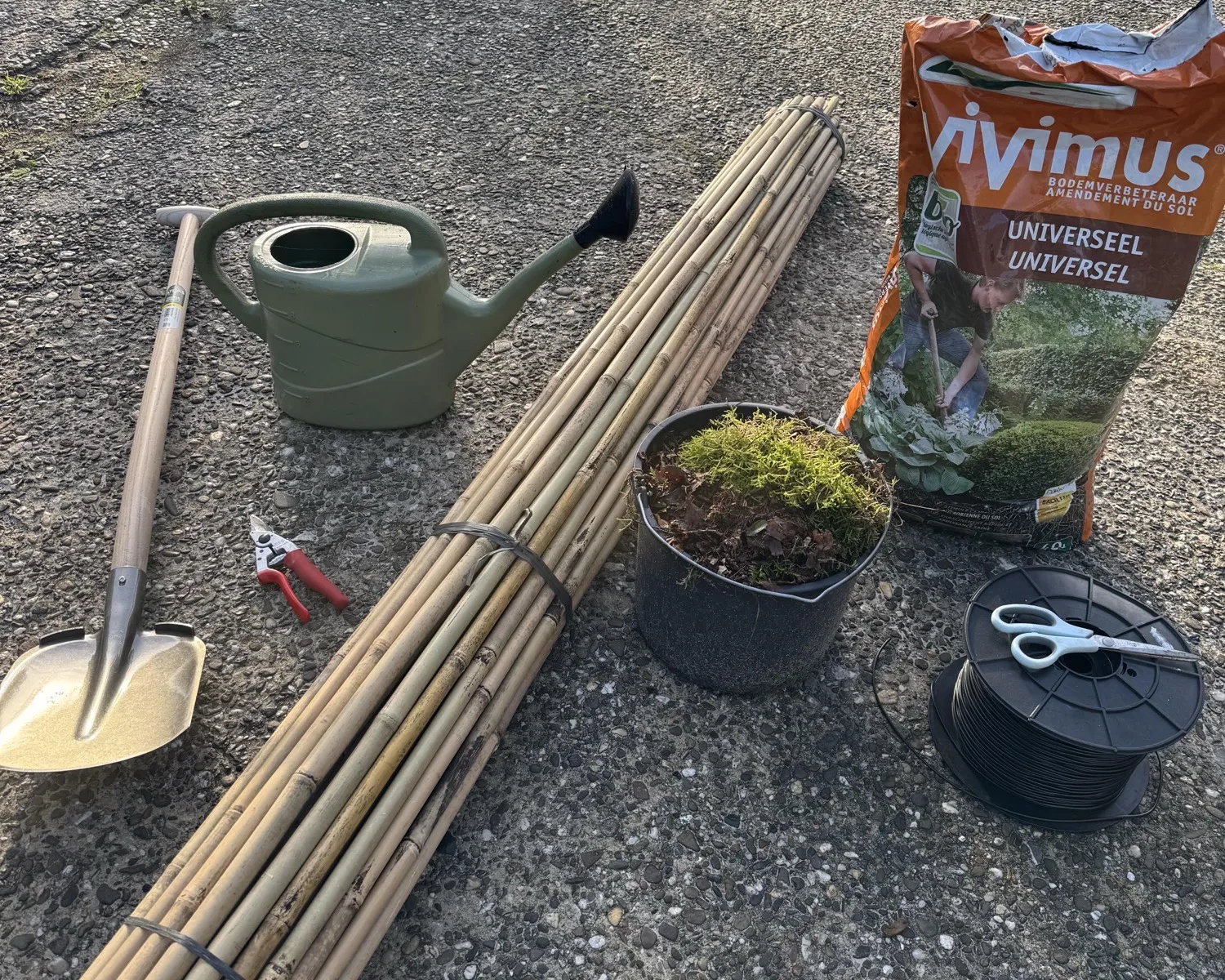
Checklist: what you need
- Bucket of water, so the roots can soak beforehand
- Secateurs, for damaged roots
- Spade
- Watering can
- Bamboo canes, about 25 mm thick and 2.5 to 3 metres long
- Tree tie tubing, to tie the plants to the bamboo canes
- Lime or gypsum (for sandy soil)
- Optional: good compost or Vivimus, forest soil, molasses, homemade liquid feed and mulch (wood chips or leaves)
One more tip from us: record your new planting in the My Food Forest app right away. That way, in three years you will still know exactly which tree you planted where and when. The app can be downloaded from 24 November.
Want to learn more about soil and plant health?
Planting a tree well is a great start, but the real work happens underground. Why does one tree die while another thrives? Should you do something about your soil or not? And how can you tell from a plant whether it is healthy?
You will learn this and more during the five-day course Healthy food forest on living soil (in Dutch) by Martijn and Stefan Nieuwenhuijsen (SoilGecko). In five days you dive into the world of soil and plant health, learn to carry out soil and plant sap tests yourself and visit Martijn’s food forest. You go home with a concrete step-by-step plan for your own project. We got a lot out of Martijn’s advice on preparing the soil for our food forest, so we can wholeheartedly recommend this course. New dates for the course will soon be on the website: devoedselboss.nl/cursussen/bodemcursus
Good luck planting this autumn!